

Deep Ocean Mining
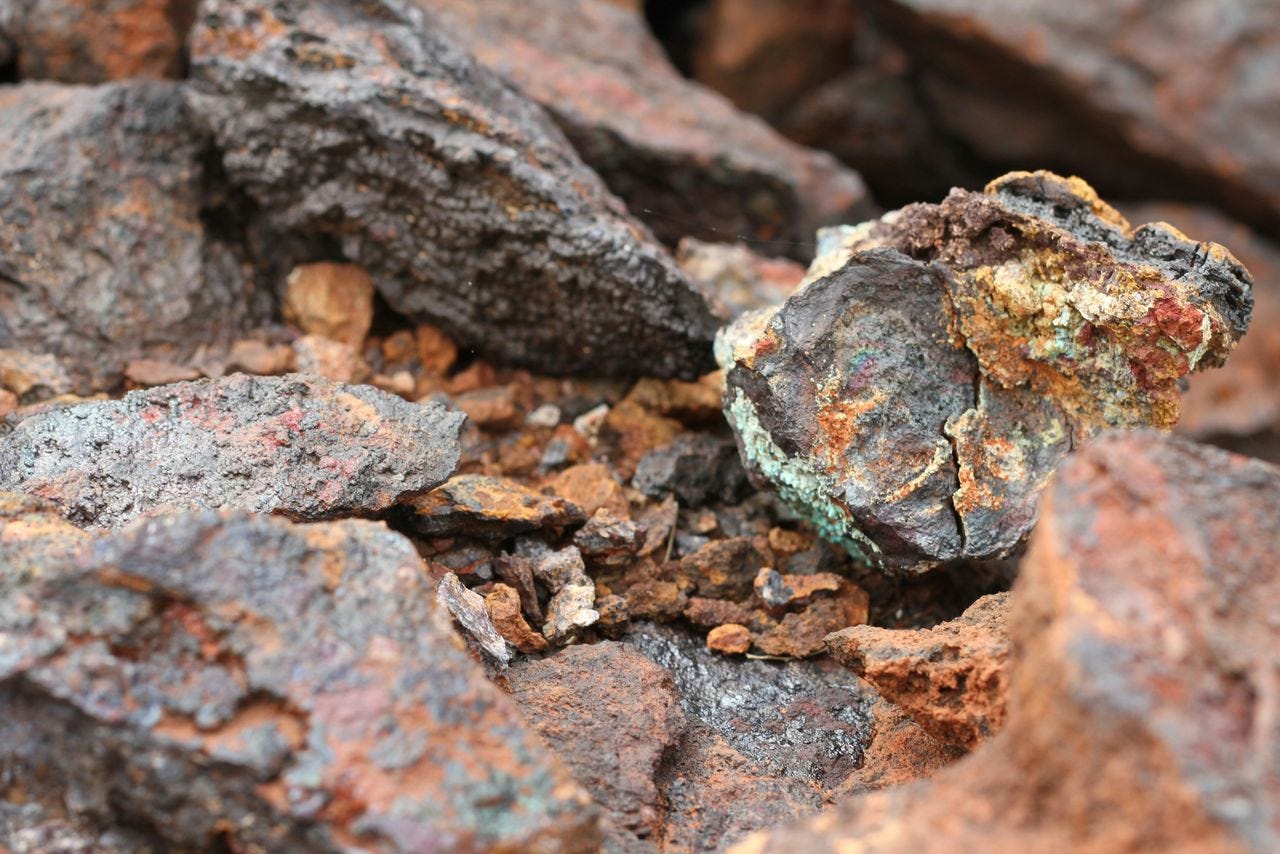
The deep ocean contains valuable minerals (⏬) which can be mined in areas that have extremely low biodiversity and very common habitat types. There are rocks (called “nodules”) lying exposed on the sea floor, containing high concentrations of Manganese (27%), Nickel (1.4%), Copper (1.3%), Cobalt (0.25%), and rare earth elements (0.05%). The nodules can be picked up by jets of water and returned to the surface for processing. These mineral-dense areas (such as the Clarion-Clipperton Zone) are vast, and there is a lot of material available -- over 200 years’ worth of global supply of Manganese and Cobalt, and about 75 years’ worth of Nickel.
It is theoretically a viable and lucrative mining source. These minerals are valuable for many kinds of technology and production that are all increasing in the coming decades. They are especially beneficial for solar power, electric motors, electricity transmission, wind turbines, and batteries. Currently 50% of nickel comes from Indonesia, a region high in evolutionary distinctive biodiversity. Net-zero scenarios require large expansions of mineral extraction from somewhere.
Deep ocean mining is not very disruptive to biodiversity for some basic reasons:
The deep ocean is 60% of the earth’s surface, so the seafloor is by far the most common type of habitat worldwide. The Clarion Clipperton Zone (CCZ) is in Abyssal Clay sediment (31% of the deep ocean floor), as opposed to biogenic sediment like Calcareous (37%) and Sileaceous (23%) ooze which are mostly shallower areas.
Habitat types are defined by variation in depth, sediment, topology, water masses, and marine snow. All of these vary extremely little across the ocean floor compared with terrestrial variation. Variation comes from the nodules themselves, as they are a hard substrate.
The seafloor cannot become as densely populated as the surface due to the energy and nutrient limitations, making it more akin to desert or tundra than to something like a forest (or the coral reefs and kelp forests that thrive in shallower waters).
This does not necessarily mean that abyssal life does not vary much genetically. Life down there may specialize for small differences in habitat and have evolved for long periods of time. Especially because this habitat is extremely stable, which fosters survival of evolutionary distinctive species. It is still unknown if the Clarion Clipperton Zone has unique life, found nowhere else in the ocean.1
Biodiversity is very low in the CCZ, and what species are present are mostly worms and organisms smaller than 1 cm. Even if the life in the CCZ is 1) unique, 2) highly evolutionarily distinct, and 3) will be wiped out forever by mining activity, there is an opening for moral judgements on the value of small, million year old, metabolically efficient wormlike life versus high-energy tropical terrestrial large vertebrates. Relying on evolutionary distinctiveness is a countermeasure against our human biases, but it is not the only value in conservation choices.2
The hope is that the deep ocean mining would displace3 highly damaging mining that is taking place elsewhere in the world, particularly in biodiverse jungle. This looks possible in New Caledonia, the Philippines, Brazil and Gabon.
The mining that is most likely to be reduced by ocean competition are nickel and manganese mines. Copper is too readily available and too large of a market to shift with ocean mining. Similarly cobalt isn’t likely to be impacted much, because it is mostly produced as a byproduct in copper and nickel mines. Unfortunately the cobalt mines in the DRC are unlikely to be closed by price reduction, as these “artisanal” (not my wording) mines are more a symptom of poverty than market demand.
Nickel:
Nickel is a small enough market that the deep ocean deposits will change the market significantly. Unfortunately the recently expanded4 nickel mines in Indonesia are relatively low cost and are unlikely to be the first to close.5 Still, nodule production may limit the growth of mining in Indonesia. There is more hope for closing nickel mining in places like New Caledonia and the Philippines, as they are higher cost and could be supplanted by nodule production. The economic disruption would likely hit marginal, environmentally damaging operations first, such as mines facing depletion. This is relevant to biodiversity in the area, as mines near depletion tend to worsen their impact by trying to scrape the last bits of valuable minerals out.
Manganese:
Manganese is available in large amounts in the nodules, so much that it will impact the manganese trade despite it being a large market. Some of the largest manganese mines are located in tropical rainforests - in Brazil and in Gabon - others are located in semi-arid regions like South Africa. The more expensive mines are the ones that are most likely to close first. Another factor is that oceanic nodules can often be processed with much less energy and less CO2 footprint than terrestrial alternatives.
Most places are more biodiverse than the deep ocean, so if deep ocean mining reduces or prevents mines almost anywhere, it would be less damaging to the environment than the deep ocean mines.
Right now deep ocean mining is being held back by environmental groups (including WWF and Greenpeace), government lethargy, and potentially the mining companies themselves that would not want to have their established businesses be interrupted by new competition. It is also held back by technology - these specialized mining rigs are not mass produced yet, in part because the supply is not accessible. Recently President Trump from the USA has opened up deep ocean mining, and the International Seabed Authority has not given a response. However, the United States is not part of the ISA and so USA companies may be exempt from ISA approval.
The technology seems accessible. Nautilus Minerals deployed successful collectors, but failed at scaling up. The Metals Company has deployed successful collectors for weeks and riser pipes at 4km deep but is waiting on NOAA and has yet to scale up to commercial production. Other mining operations have been able to run for months at a time. The biggest technological challenge seems to be the risers (elevators transporting the nodules to the surface). But this part of the process has multiple potential routes forward, so it seems likely that it is only a matter of time until it is solved economically. Once the technological difficulties have been overcome, scaling up will be dependent on manufacturing and investment rather than the richness of the mineral vein (unlike traditional terrestrial mining). This industry seems to me to be very close to opening up. Some deep ocean mining companies are planning to start operations in 2027 and 2028.
It is possible that this backfires if deep ocean mining makes nickel, manganese or rare earth metals cheap enough to encourage complimentary mines, say of lithium, to open in biodiverse hotspots. This depends a bit on how valuable the green energy transition (and other technological developments) is for biodiversity. I leave that to other climate research orgs, like Giving Green, to evaluate.
To read more about the deep ocean, metals, and deep ocean mining, see the “Critical Ocean Minerals Research Center” website. For counterpoints see this scientific article and this scientific american article.
Final conclusion: What if opening the deep ocean to mining leads to extensive permanent damage to the sea floor? Will I regret this damage, looking back after hundreds of years? Maybe. I think our conservation should be based on overall extinctions and loss of the tree of life. With this in mind, I think the positive effects on biodiversity outweighs the losses from deep ocean mining. The numbers of species are just too small compared to the known damage of terrestrial mines.
The deep ocean is poorly surveyed. Those surveys that have been done are concentrated in the CCZ and other minable regions. This makes it difficult to draw any conclusions about the other regions of the ocean floor.
We may be time-blind to the excitement and value of slower, longer lived species than ourselves.
Fortunately this is not open to a Jevon’s Paradox situation because this is increasing the available non-biodiversity-damaging supply of minerals only. Not terrestrial mines.
A few years ago, when China figured out how to process low-grade laterite ores using HPAL processing, this really popularized nickel laterite mining in Indonesia and shuttered several higher cost mines in Australia and elsewhere.
It’s not impervious to competition. Mining did slow down and the Indonesian government made efforts to limit supply a year ago when nickel prices dropped. So they are susceptible to impact.