

Fertility Control
One of two types of invasive species control
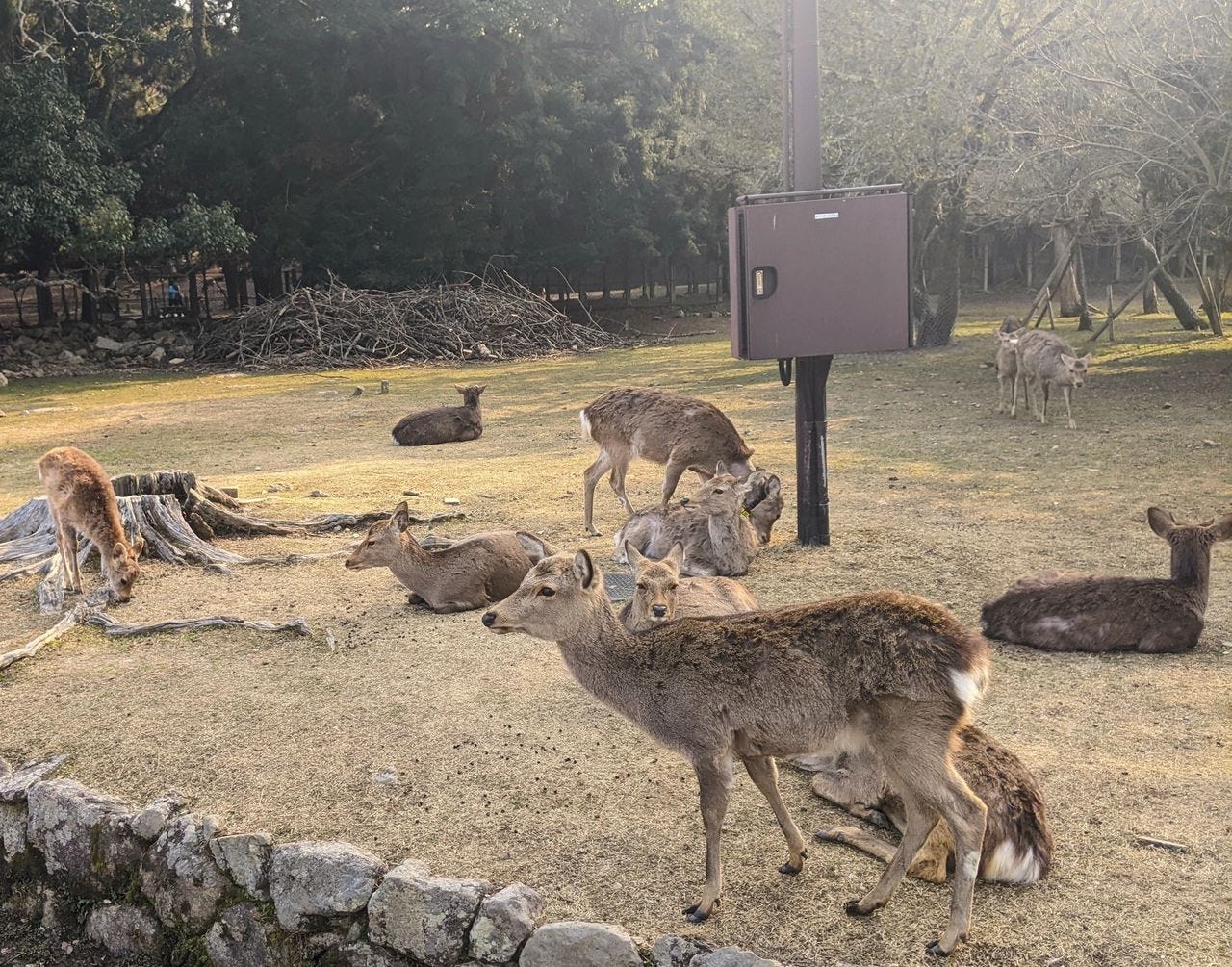
Fertility Control means using long-lasting contraceptives to control the reproduction of species whose populations would otherwise balloon to ecologically unhealthy levels. Often these are species whose natural predators have been hunted away by humans, or invasive species that lack the predation, competition, or disease pressure they experienced in their original environment.
Fertility control is currently used on horses and deer in some places.
Wild horses in the United States are typically shot with darts containing a fertility-control vaccine. Unfortunately, many horses have learned to stay out of shooting distance. And the fundamental strategy of shooting darts, while more humane than shooting to kill, is not much less labor-intensive. (Assateague Island’s population-control program counts every horse on the island six times a year!)
Hastings on Hudson in the United States has trialled deer bait that contains contraception.
The Botstiber Institute (International Conference on Fertility Control for Wildlife), Faunalytics, and the Hastings on Hudson Deer Immunocontraception Project are all sources of information on this intervention.
Long-lasting contraception seems preferable to culling from an animal-welfare standpoint, and is also potentially less labor-intensive if cheap, scalable delivery methods can be found.
However, overall, fertility control interventions do not seem promising, because:
2-3 years of immunocontraception is the longest duration achievable by most methods, due to biological mechanisms which break down doses over time. (Although there is 2019 paper showing effectiveness of one treatment for 5-10 years by using a slow release mechanism, so future progress might be possible here.)
Some species are not viable candidates for contraceptives:
Feral cats are perhaps too beloved to be managed.
Commercial livestock might eat contraceptive bait.
Cane Toads and rabbits produce so many offspring that fertility reduction would need extremely high success rates to have an impact.
Contraceptive control is not an option for dealing with invasive insects, fish, and amphibians. This is because of their reproductive rate, brood size, lack of hormone controlled fertility, as well as delivery methods not being able to reach a high percentage of the population.
Plants and fungi also can’t be controlled via current sterilization techniques because they produce hundreds to millions of seeds/spores, and most sterilization is very coarse grain methods like “heat” and “chemical burning” that would damage surrounding species equally. Viral control methods are one of the few targeted methods we have.
In most instances, culling and poison are far cheaper and far more effective.
Gene drives have many similarities to fertility control via contraception, but have some important differences – they would be self-spreading, as permanent as we design them to be, and have very high rates of effectiveness. This addresses many of the current drawbacks of fertility control via contraception. Gene drives work by being a genetic snippet that has a virtually 100% chance of being passed on. See our previous coverage:
“Gene drive technologies show promise for eradicating invasive species, particularly mice on islands. The main coalition is called GBiRD for Genetic Biocontrol of Invasive Rodents. New Zealand and Australia have active research programs in this area. All of these gene drive efforts are still in research phases. The current technique is to have a gene that ensures all future mice are born sterile until the population crashes. If the gene escapes into other populations out in the world (a real concern with mice) the gene is preset to self-eliminate after a set number of generations, or could be tied to a mutation that only occurs in the target population. This would safeguard against causing lasting harm in mice elsewhere in the world.”
Overall, fertility control feels doubtful to be a scalable intervention. I really want it to be highly effective, but the current applications are really lacking. As far as I can tell baits are not currently an option and each species will need its own contraceptive program plus delivery mechanism. That said, I don’t understand why there is not more of a push for this, because it would be a far better replacement for the current methods. Gene drives seem uncertain to arrive anytime soon, (5-10 years?) although they would be more widely applicable once they do arrive.
Update Aug/2025: Conservation X Labs is now working on this!