

30 June 2025

In conservation we want to save every single species, but reality has other plans. So the question becomes: how do you choose which to save and which to let go? Which is more important, lions or tigers or bears? And how do we rank every single living creature?
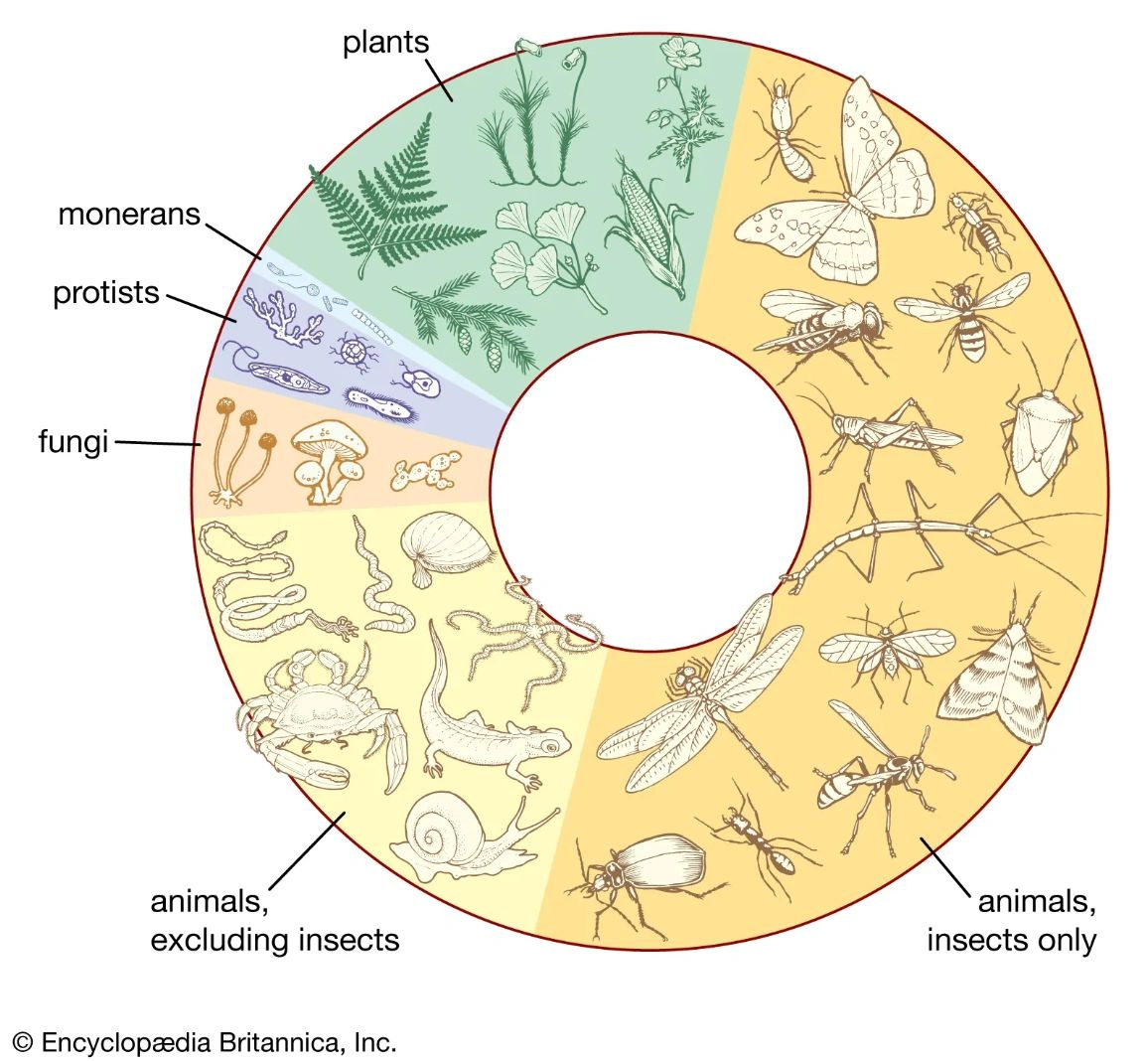
If I showed you a map of the tree of life and told you to “pick 10,” you’d try to select as many different ones as possible. A dog, bird, a fish, a plant, a tiger, etc. No one would pick 10 butterflies because we like variety. We do this not just for the sake of scientific pursuit, but for the ecosystem, and for our own enjoyment.
Which half?


We want an objective way to measure “uniqueness,” or “importance” between species on the tree of life. One way wildlife scientists try to do this is by measuring functional traits representing species’ importance to its ecosystem. They use proxy traits like “seed size” and “trophic level,” but these are far from what we really mean by uniqueness and functional traits. Trying to measure all the important characteristics of species, (their lifehistory, their behavior, their body types, the chemical pathways inside their cells, everything that makes them what they are) and then compare between species is a philosophical mindbender on top of a standardization nightmare. It’s simply too complex to do objectively with our current abilities.
Introducing Evolutionary Distinctiveness
This is why evolutionary distinctiveness is a nice, easily measured proxy for “species uniqueness.” It’s a single number representing the distance between species on the tree of life. The more distance between species, the more of the tree of life is captured by them.
Evolutionary distinctiveness is measured by counting the number of genetic changes between species. It can also be thought of as the years of evolutionary divergence between a species and its relatives. The length of time it takes to evolve from one species to another - usually about 10 million years.
And where does that get us?
With this we can handily solve the problem of prioritizing which species are important. We want to save as much of the tree of life as possible, and can use evolutionary distinctiveness to maximize the diversity of species we save.
We need a way to focus our attention between the approximately 2.24 million endangered species (28% of IUCN assessed species are T&E and there are ~8 million species globally. Unassessed species have roughly the same rate of being T&E, if not higher). With Evolutionary Distinctiveness as a metric, we can look at the impending extinctions and know which extinctions are going to cut down the tree of life. We will be able to tell between which extinctions are more likely to destroy rare and unique aspects of life on earth. And which extinctions are going to be less devastating losses that have other species that share traits or can potentially partially fill in for the loss. We can better answer for the entire global panoply of species, when and where we spend our limited resources to save as much of the tree of life as possible for Our Future. Effective Altruism excels at this kind of moral calculus. We have to look at some way of assessing how to make choices with imperfect knowledge, decisions which we’d rather not make at all.
Ancient lineages represent unique evolutionary experiments that can never be repeated. When the last tuatara dies, 200 million years of evolutionary innovation dies with it. It’s not just the ecosystem role, it’s the biochemical pathways, the evolutionary history, structural innovations, time-tested successful adaptation strategies, and other traits we haven’t even thought to notice yet. It’s a life path we could have gone down, but didn’t.
No single number can capture the full story of a species’ uniqueness. But if you tried to, Evolutionary Distinctiveness is how you would. It measures “uniqueness” and “distance” between species on the tree of life. It serves as a nice numerical indicator of the trait diversity, functional diversity, and uniqueness of all species across the tree of life. Granted, genetic change isn’t the same as physical expression, but it gets us reasonably close.
So how is this magical number calculated anyway?
We calculate Evolutionary Distinctiveness (ED) by the sum of branch lengths connecting it to the root, with shared branches divided among descendant species. Simply put, evolutionary distinctiveness is the number of genetic changes it takes to go from one species to the next. This can be thought of as either “genetic steps” or “evolutionary time.” It quantifies how isolated a species is on the tree of life.
If you are curious about some of the nuance I digress a bit here:
There are obstacles: Genetic steps is not just “how many flips in As, Ts, Gs, and Cs.” A whole-genome duplication might happen in one generation, while accumulating an equivalent length of sequence divergence through point mutations might take millions of years. But if it was duplicated in a single event, it is counted as a single event. This is not a perfect science. Break Point analysis is one tool to count rearrangement events, rather than just tallying the number of genes that are different between species. There are many other similar complexities, tools, and methods that go into estimating ED. It is a developing science.
Genetic steps capture the difference between species most accurately, but there is a shortcut. Counting “evolutionary time” requires less genetic information. Using molecular clocks in the genetic code we can instead count how much time passed between species evolutionary branches. (This might be considered more “fair” for slow evolvers like plants, species with low metabolisms, long generation times, small population sizes, and non-parasites) Fortunately genetic steps and evolutionary time are similar, since genetic changes are typically relatively constant over long stretches of time. Using evolutionary time may also represent real time-dependent solutions that take that much time to develop. But mostly it’s just much more practical given the genetic records we have to work with at this time.
When tallying up total evolutionary distinctiveness for a species, we divide each branch length by the number of species that share it. So if a branch leads to 3 species, each species gets 1/3 of that branch’s length credited to its distinctiveness total. Each species has its own branch tip, unique to that species. Most of a species score comes from the last piece of the branch where it “owns” 100% of the branch. Deeper down the branches, it often gets divided up between so many other species that it does not add much to the evolutionary distinctiveness score of any one species.
Unless you don’t have any close living relatives.
Consider the Ginkgo tree, the sole survivor of an entire division of plants that once dominated Earth’s forests. It has about 200 million years of evolutionary distinctiveness. The Ginkgo tree produces unique chemical compounds that improve blood flow and may protect against dementia—compounds found nowhere else in nature. The tree is also remarkably resistant to most fungal pathogens, bacterial infections, and insect herbivory. Far from being outdated and ill suited to modern threats, it is better equipped than many.
The average evolutionary distinctiveness is about 10 million years of evolutionary history. But some species have much more. The Ginkgo has 20x that, and there are species with up to 30x that amount. Typically this is because they split off from the tree of life very early. The top 0.001% of ED species (roughly 50-200 globally) are lonely champions with over 100 million years of isolation. Each tier down contains 10-100 times more species but with roughly 10 times less ED per species. Protecting the top 100 ED species might preserve as much evolutionary history as the bottom 10 million species combined. That may sound like a lot, but consider the platypus compared to the Cuban boa, Jamaican boa, Puerto Rican boa, Hispaniola boa, Turks and Caicos boa.
Which types of species tend to have the most ED?
Sponges often have high ED. Plants, fish, and reptiles are more likely than birds and mammals to have top scoring ED species because of their deeper roots on the tree of life. Mammals and birds max out at “just” 80my because they are relatively recent radiation from a common ancestor shared with many other living species. But considering the top plant (200my) and reptile (200my) are a bit more than double the top mammals and birds (80my), and the tiers are leptokurtotic so there are very few extremely high ED species and many recently diverged species. 80my is still very high. Still in the top 0.1% of high ED species. So it’s not like sponges dominate the top ranks of ED before you hit any other species. They just are more likely to have more of the highest scoring ED species.
So why do high ED species get to be so far afield from the rest of the tree of life? What made them special?
All species continue to evolve, but some species have split out into many relatives. Species with high evolutionary distinctiveness have usually lost their relatives. High ED species often appear “ancient” but that is a trick of perspective. When a lineage loses all its relatives, they are going to look “old” because there is nothing recent to compare it with. So when describing coelacanths one naturally ends up referring to early fishes because the alternative is trying to describe coelacanths as “like extinct fish like coelacanth.” Which is not very illuminating! Even if there are many species that it did resemble, the average person won’t recognize those extinct species until you go way back in time. In addition to losing their relatives, high ED species often survived because they were well adapted to stable locations. That being said, evolutionarily distinct species have been shown to evolve slower and produce fewer species.
Are high ED species just dying branches of the tree of life?
But just because they are the last remaining members on their branch, does not mean they are an evolutionary dead end. These species have survived global catastrophes and climate shifts in the past. It is not “just a matter of time before they fade away.” They have the potential to radiate and produce a great diversity of successful species once more.
Look at mammals. Mammals were once a few hundred species squeezed out by dinosaurs and forced to be nocturnal. If you looked at them during their low point (10-40 species) you might assume that they were a failed branch of the tree of life. Instead, mammals got lucky that their specialties were some of the best for surviving asteroid strikes and volcanic eruptions. Their set of traits (small, omnivorous, burrowers) allowed mammal evolution to take off and dominate the globe. Before this, they spent a hundred million of years of surviving with just a few hundred species living in obscurity.
Conservation of evolutionary distinctiveness means very different actions than conservation of “lots of species.”
In many biodiversity hotspots there are “lots of species” but they are very recently diverged species. Islands are hotbeds of evolution and adaptation. However, they are mostly recent divergences. Therefore islands are not places to find high ED species. More importantly, they are very similar in traits, appearance, niche, and genetics to each other and to the mainland. Yes, they are still valuable, interesting and different. But they are not that different. With current methods of using “biodiversity” based on speciation, island species get an unfair boost by getting to the 5mya mark and becoming a “new species” rather than being recognized as small gradation “variations” on many other species. They may even re-evolve back together again (reverse speciation or lineage fusion), which can happen in species which are less than 1.5 million years diverged. (or 6mya if you are a plant). Another nail in the coffin is realizing that most islands sink back into ocean after 10 million years, naturally taking those species with them unless some recolonize the mainland (and most do not).
UNLESS the island is big enough to be an entirely new system. See Socotra, Madagascar, and Australia. These are locations of both high biodiversity and high ED!
Instead of protecting vast island reserves with thousands of closely related species, we might prioritize tiny refugia harboring a few ancient lineages. Evolutionarily distinct species are “remnants” that are found in a few highly stable locations - ancient lake bottoms, caves, deep ocean, tropical mountains which create refugia, and areas with Godwanan relics like some deserts and the mediterranean. High ED species often have very restricted ranges and low dispersal. Which means it is we can make hugely leveraged actions by preserving very small remote areas. It also means that high ED species cannot easily survive elsewhere. They also will not necessarily fall under the umbrella of conservation that is currently being deployed.
Examples of good places to preserve evolutionary distinctiveness are Madagascar, Socotra, Australia, Seychelles, New Caledonia, Western Ghats, Valdivian temperate rainforest, Lake Baikal, karst regions of Vietnam and Thailand, and deep ocean seamounts.
The hope is that conserving ED will also pick up on and preserve many other things - the widest variety of traits, of ecosystem services, of adaptation potential, of biochemical pathways, of the evolutionary history of our planet. Potentially even things we don’t know about yet. Using Evolutionary Distinctiveness is a way to objectively spread out our efforts to preserve the widest variety across the Tree of Life as possible.
Preserving evolutionary distinctiveness seems like a much more useful way to think about preserving life on earth, and it seems to be neglected currently. It is gaining support, some international agreements such as the Global Biodiversity Framework (Target 4, Indicators) of the Convention on Biodiversity have sections endorsing evolutionary distinctiveness and protecting the tree of life.